
Active Listening Exercises Couples Can Practice at Home

Your partner is talking. You’re nodding. But inside, you’re replaying the argument from last week, or thinking about what’s for dinner, or waiting for the moment you can finally say how you feel.
In moments like that, it’s easy to be present physically but not fully there.
Active listening, the kind that actually positively changes a relationship, is something most of us have to learn. But you don’t need to be in couples therapy to build these listening skills. They can be practiced at home, starting today.
What Is Active Listening in Relationships?

What is active listening in a relationship? Active listening in relationships is the practice of giving your partner your full attention, not just to their words, but to what they might be feeling underneath them.
It means slowing yourself down long enough to pause your own reactions, stay curious instead of defensive, and listen to understand rather than prepare your response.
Can active listening improve emotional intimacy? Yes, when partners feel heard and understood, it naturally builds trust, safety, and emotional closeness over time.
In couples therapy and couples counseling, active listening is often one of the foundational communication skills couples learn to rebuild connection and reduce misunderstanding. Because it communicates: I’m here with you, not just hearing you, but trying to understand you.
Why Active Listening Matters for Couples
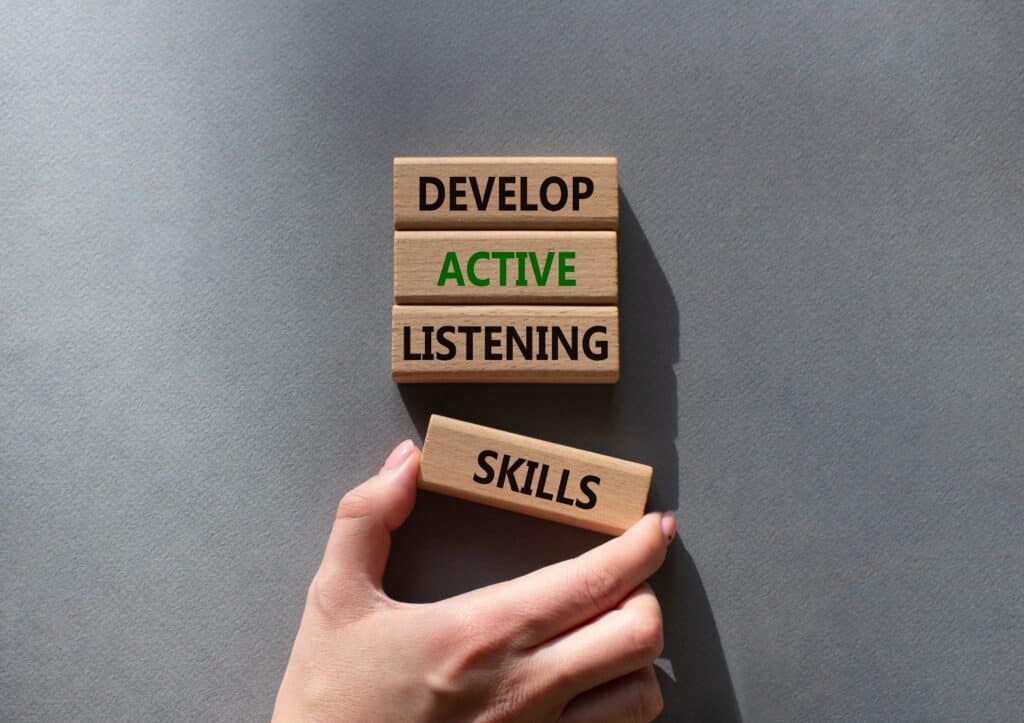
Why is active listening important in relationships? Studies in couples therapy consistently show that feeling heard and understood is one of the strongest predictors of relationship satisfaction. It’s not about whether couples disagree or face conflict. It’s about whether each person feels their partner truly understands them.
How does active listening reduce conflict between partners? Definitely. Because most arguments aren’t really about the dishes or the plans that got cancelled. They’re about feeling unseen. When someone feels genuinely heard, the defensiveness drops and they’re able to express themselves.
The reverse can also impact relationship dynamics. When couples stop genuinely listening to one another, relationship issues grow, emotional distance builds, and partners can begin to feel alone even within the relationship.
Common Listening Mistakes That Create Conflict
What are common listening mistakes in relationships? Watch out for these traps:
- Waiting to talk: Your mind is already forming a response while your partner is still speaking
- Fixing instead of feeling: Jumping to solutions before your partner feels understood
- Interrupting: Cutting someone off signals your thoughts matter more right now
- Going defensive: Hearing feedback as an attack and building your case instead of listening
- Bringing in the past: Dragging up old arguments to win a new one
The Speaker–Listener Technique Step by Step
What is the speaker–listener technique? Developed by relationship researchers Dr. Scott Stanley and Dr. Howard Markman, the Speaker–Listener Technique has been used by mental health professionals in couples therapy and couples counseling for decades. It provides a simple, structured way to navigate difficult conversations by helping partners feel heard before moving into problem-solving, reducing misunderstandings and defensiveness.
Here’s how it works:
Step 1 — Choose roles. One person is the Speaker and one is the Listener. Grab a small object, a pen, coaster, or anything nearby, to act as the talking piece. Only the Speaker holds it.
Step 2 — The Speaker shares. Talk about what you’re feeling. Keep your thoughts brief, use feelings-based language, and pause often.
Step 3 — The Listener reflects. Before responding, reflect back what you heard. Try phrases like, “What I’m hearing is…” or “It sounds like you feel…” No rebuttals, problem-solving, or advice.
Step 4 — The Speaker confirms. Let the Listener know whether they understood you correctly. If not, clarify, and let them reflect again.
Step 5 — Switch roles. Once the Speaker feels heard and understood, switch roles.
It may feel awkward at first, which is normal, but by slowing the conversation down, this technique, commonly used in couples therapy, helps build stronger listening skills and creates more space for genuine listening and understanding.
Reflective Listening Exercises to Practice at Home
The Daily Debrief
How can couples practice active listening at home? Set aside a few minutes each day for uninterrupted sharing. One partner speaks for about two minutes about something from their day, while the other listens and reflects back, without giving advice or making comparisons. Then switch roles.
Emotion Labeling
When your partner shares something, name the feeling beneath the story. “It sounds like you felt invisible in that meeting.” You might get it wrong and that’s okay. When you do, your partner clarifies, and understanding deepens.
The Mirror Exercise
Sit facing each other. One partner shares a thought in two or three sentences. The other repeats it back as closely as possible. It feels strange, but it proves to your partner that you truly absorbed what they said.
How to Validate Your Partner’s Feelings
How can I show my partner I truly understand them? Through validation. Many people assume validating someone means agreeing with them, so when they disagree, they either stay silent or push back. But validation is not the same as agreement.
Validation means communicating: Your feelings matter. I’m trying to understand your experience instead of dismissing it.
You can believe your partner overreacted and still say: “I can see why that upset you.” Both things can be true.
Simple validating phrases used in couples therapy and couples counseling:
- “That sounds really hard.”
- “I understand why you’d feel that way.”
- “It makes sense that you’re frustrated.”
- “I hear you.”
When people feel validated, they often become less defensive and more open to listening and problem-solving. Validation helps create the emotional safety needed for a genuine conversation to begin.
Using “I” Statements to Improve Understanding
“You never listen to me.” “You always make me feel invisible.” “You’re so checked out.”
Even when they come from hurt or frustration, they land as accusations. The other person hears blame, gets defensive, and the conversation shifts away from understanding.
But “I” statements focus on sharing your experience instead of blaming, a communication skill often encouraged by mental health professionals and used in approaches like emotionally focused couples therapy.
A simple formula is: “I feel [emotion] when [situation] because [reason].”
For example: “I feel disconnected when we don’t talk after work, because that time together matters to me.”
Practice using “I” statements in lower-stakes moments so they feel more natural when emotions are running high.
Nonverbal Communication and Active Listening
What are examples of active listening exercises for couples? Research shows that communication is shaped not only by words, but also by eye contact, posture, facial expressions, and physical presence. Your body is communicating, whether you intend it to or not, something often explored in couples therapy when partners feel unheard or emotionally disconnected.
When you’re genuinely listening, your body often reflects it:
Eye contact: Soft and steady — present and engaged, not intense or distracted
Open posture: Facing your partner, arms relaxed, leaning slightly in
Nodding slowly: A quiet signal that says, I’m with you. I’m following.
Phone face down: A simple way to communicate attention and respect
When your words say “I’m listening,” but your eyes are fixed on a screen, your partner notices the disconnect. In close relationships, physical presence is part of how listening is felt. A couples therapist or marriage counselor in couples therapy may help partners recognize these patterns and practice ways of communicating that feel more present, connected, and emotionally safe.
Weekly Relationship Check-In Exercises
How often should couples practice communication exercises? Healthy communication doesn’t only happen when something goes wrong. Many couples create regular space for honest conversations, helping small frustrations, misunderstandings, or unmet needs get addressed before they grow.
A weekly relationship check-in can take just 20 to 30 minutes. No phones. No distractions. Just dedicated time to reconnect and understand what’s happening in each other’s world.
Take turns asking questions like:
- What was your high and low this week?
- Was there a moment you felt disconnected from me?
- What’s one thing I did that you appreciated?
- Is there anything you need more of right now?
Keep the tone curious, not interrogating. The goal isn’t to solve everything in one conversation. It’s to stay connected, strengthen emotional awareness, and make communication a regular practice. Similar exercises are often used in couples therapy to help partners build a healthy relationship.
How to Stay Calm and Present During Difficult Conversations
Even strong communicators can struggle when emotions run high. When you feel flooded, heart racing, jaw tight, mind spinning, your brain shifts into protection mode, and listening becomes harder.
So how do you respond without becoming defensive? Pause.
Try saying: “I want to keep talking about this. Can we take ten minutes first?” Pausing gives your brain a chance to relax and reset.
Other tools that can help you stay grounded:
- Breathe before you respond: One slow breath can help slow reactivity in a tense moment
- Drop your shoulders: Stress shows up in the body; releasing tension can help signal safety
- Speak more softly: A calmer tone often helps regulate both you and your partner
- Stay with the present issue: Resist turning one disagreement into every unresolved frustration
These active listening skills are often practiced in couples therapy with family therapists, especially when partners feel stuck in cycles of defensiveness, shutdown, or conflict.
You are not enemies trying to win an argument. You’re two people trying to understand each other and work through something difficult together.
When Active Listening Isn’t Enough
There are moments when communication tools and active listening skills help, but they don’t fully shift what’s happening between two people. You can listen better, speak more carefully, even try every exercise… and still feel stuck in the same emotional loop.
So when should couples seek therapy instead of practicing at home? Couples therapy can help when:
- The same conflict keeps coming back, just in different forms
- Conversations quickly turn into shutdown, defensiveness, or escalation
- There’s distance in the relationship that feels hard to close
- Trust feels fragile, even when both people are trying
A couples therapist, family therapist, or marriage counselor isn’t there to decide who is right. They help slow things down enough to understand what each person is actually reacting to, the patterns underneath the words.
Using Active Listening to Enhance Your Relationships
If you’re here, it likely means something in your relationship already matters enough to try. You don’t have to figure it out alone. You can book a free call to explore couples therapy sessions with one of our marriage counselors or mental health professionals and see what support could look like for your relationship. You can also explore how integrating individual growth into couples therapy can support both your personal development and your relationship at the same time. We’re here for you.